
Know today whether your patient with diabetes will lose kidney function over the next 4 years.
INNOVATIO-ND2 is a predictive test based on protein biomarkers. eGFR and ACR tell you how the kidney is today; INNOVATIO-ND2 tells you where it is heading and how fast, from a single blood sample.
CPT 0385U · Covered by Traditional Medicare, MCS (Advantage and commercial) and MMM (Advantage and Vital)
One test, three answers
Validated as a predictive test in more than 4,000 patients, including the CANVAS study population.
Is diabetic kidney disease already present?
A result above 30% indicates kidney disease is present, even when ACR and eGFR look normal.
Will eGFR fall by 30% or more?
Classifies the risk of an eGFR decline of 30% or more over the next 4 years as low, medium or high.
Fast or slow progression?
When kidney damage is present, it separates slow, medium and fast progressors without years of serial eGFR.
What each test tells you
| Test | Current kidney function | Future kidney function | Rate of decline |
|---|---|---|---|
| INNOVATIO-ND2 | Yes | Yes | Yes |
| Urine albumin-to-creatinine ratio (ACR) | Yes | No | No |
| Estimated glomerular filtration rate (eGFR) | Yes | No | No |
ACR and eGFR only detect diabetic kidney disease once damage has occurred, and they are not always conclusive. INNOVATIO-ND2 identifies the risk earlier, so you can tailor the plan and track the response.
Each risk level comes with a plan
The report does more than classify: it tells you what to adjust and when to retest.
Clinical interpretation guide
A sample report explained: how to read diagnosis and prognosis, and what to do at each risk level (in Spanish).
Download PDFWhich patients are candidates?
eGFR above 60 and/or no microalbuminuria
They look "healthy", but their prognosis is uncertain. Knowing future risk lets you adjust the plan before damage appears.
Stages 1 to 4
You know the stage; now learn whether it is progressing slowly, moderately or fast, and act with the right urgency.
How to order
- 1Patient with type 2 diabetes, fasting.
- 2Physician order with ICD-10 code E11.22 or E11.8 and CPT 0385U, signed with license and NPI. Download the order form (in Spanish)
- 3Blood draw at one of 56 experienced laboratories in 32 towns, or at any Laboratorios Borinquen branch. See laboratories by town
- 4Processing at Immuno Reference Lab, in a monthly run.
The evidence
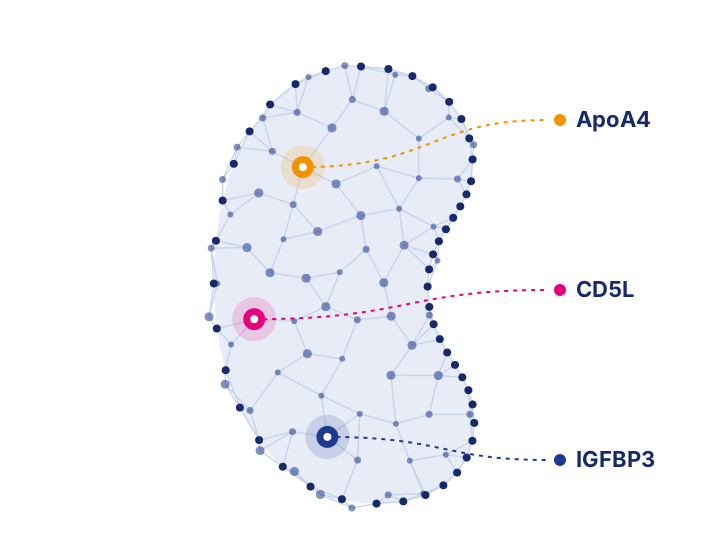
PromarkerD algorithm: three blood biomarkers (ApoA4, CD5L and IGFBP3) combined with age, HDL and eGFR.
Validated in the CANVAS study: Peters KE et al., Journal of Clinical Medicine, 2020. The ELISA assay is clinically equivalent to the original mass-spectrometry platform.
With kidney-protective therapies available (ACEi, ARB, SGLT2i, GLP-1 RA, finerenone), knowing the risk lets you act and measure the response on follow-up tests.
See all studies →Thinking of a patient with diabetes and a "normal" eGFR who worries you?
In 10 minutes I'll show you how to read the result and how it fits your practice.
Luben Ron · CEO and Co-Founder · luben.ron@omicssolutions.com